How Seaweed is helping farming face a new future
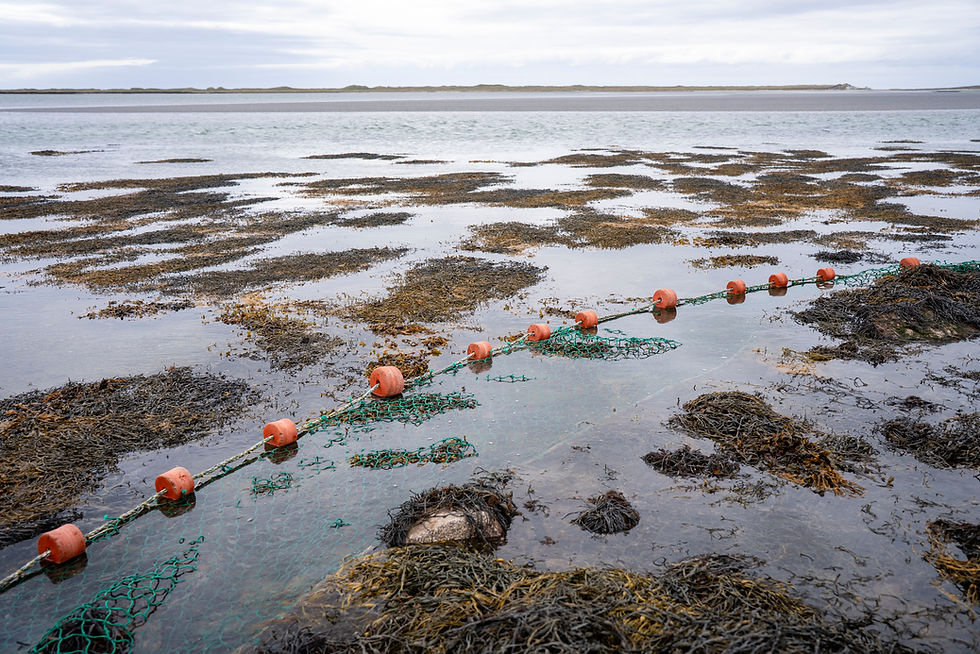
It’s low tide around North Uist, a remote island off the West Coast of Scotland. Dark tendrils of seaweed lie glistening on the rocky shore, and a lone figure in orange waders moves methodically along the bay, slicing the seaweed with a sickle-shaped blade known in Gaelic as a ‘corran’. Angus MacDoughall has been harvesting seaweed on and off since he was 17 when his fishing work dried up. Now at 73, he still harvests three to four days each month.
“It gets you out of the house, gets you moving,” he explains, “I’m not someone who could ever sit at home.”
His silver blade gleams as it flashes along the rocks, slicing the fronds of seaweed. “It’s getting a bit sore on my back now, but I suppose as you get older the bones start to creak.” He then adds with a wry smile, “you make a good bit of money through it as well. That’s the important bit.”
MacDoughall is harvesting Ascophyllum nodosum, also known as rockweed in many areas of the world. It’s been used for centuries by local people as a way to enrich the soil and support their crops.
Now, that knowledge has evolved into a more sustainable harvesting operation, extracting the biologically active compounds of this seaweed and turning it into an agricultural biotechnology with three major benefits: supporting crop growth in difficult conditions, restoring soil health, and removing carbon from the atmosphere, a key action for tackling climate change.
Seaweeds are more effective at capturing carbon than plants, partly due to their high photosynthesis rates. As a result, seaweed has been identified as a potential carbon sink that could help mitigate climate change and its potential has drawn attention from researchers keen to explore how this could be used in a multitude of industries, from agriculture to feed and food supplements. One such example is Acadian Plant Health, a biostimulant company which formulates solutions for agriculture.
Acadian Plant Health says it is careful never to remove more than 25% of the seaweed from any given area each year. The way Acadian harvest the seaweed ensures it grows back every year so it recaptures carbon as it regrows, they explain. In the same way you prune a hedge, they cut back the plant so the base remains and can regrow.
It’s the job of Casey McIntyre, resource manager for Acadian Plant Health in Scotland, to coordinate their team of independent harvesters and make sure this target is maintained. Similar to pruning a tree, cutting the seaweed can encourage it to grow back to its pre-harvest state quicker, increasing the CO2 uptake.
While some harvest with the boat-and-rake method introduced by Acadian, others prefer the traditional approach of their forefathers, hand-cutting the seaweed at low tide with a sickle-shaped blade.
Beyond sequestering CO2, Ascophyllum, sometimes called Asco, has many properties that make it worth harvesting. “It’s a really resilient plant,” explains McIntyre. Unlike kelp, which grows in deeper water and remains fully submerged, Asco grows in the tidal zone, spending half the day in freezing cold water and the other half drying out on rocks.
It has adapted to tolerate harsh conditions of freeze and thaw, dehydrating and rehydrating with the tides. By extracting the seaweed’s bioactive compounds in their processing facility and turning them into agricultural solutions, Acadian Plant Health says it is able to transfer Asco’s resilience to crops, when the biostimulants are applied directly to them.
Read the full story at BBC Storyworks (VPN required if accessing from the UK)


